
Cohutta Cat 2026: Friday the Thirteenth
2026 has had no shortage of disappointing race reports. I've raced my bike six times on three continents this year, and I don't have a single strong result to show for it. Cohutta Cat, in the mountains of North Georgia, is my fourth DNF in a row. I'm on a streak of disappointment and bad luck.
The Arkansas High Country, a 1,000-mile gravel race, was supposed to close out my season. Then my Achilles flared up at mile 180, and I was out. I couldn't stand to end the year there, so I went looking for one more race, something that would let me finish 2026 on a high note, or at least not such a low one. Cohutta Cat fit. It's on the short end of the racing spectrum for me, but what the course lacks in distance it makes up for in difficulty. My plan was simple: show up, ride my own race, and finish. I really just wanted to finish. If I rode well, I knew I'd have a solid shot at a new FKT and a race win, something that had eluded me all year. But finishing was the goal.
The race started at Mulberry Gap, which bills itself as a rustic haven, the ideal basecamp for your adventure. It's a charming collection of cabins and campsites with a little store and a dining hall. I didn't pay for any of it. I'm a cheapskate, so I camped in the woods a little ways down the road the night before. It was good sleeping weather. What I should have checked was the calendar. At 8:00 a.m. on Friday, November 13th, I rolled out of Mulberry Gap with thirty-odd other racers. Maybe that's where my bad luck started.
It was 39 degrees on the start line, chilly but not freezing, cold enough for a long-sleeve base layer and gloves. I decided against leg warmers. That decision would come back to bite me within a few miles.
We set off up a steep gravel climb in no particular hurry. One of the best things about ultra racing is how low-stress the starts are (except for Unbound XL!). Half a mile in, the peloton had already strung itself out into a long, disjointed line of riders, each of us settling into our own pace.
The first two climbs were the hardest of the entire race. We turned onto the Pinhoti Trail and wound our way up about 2,000 vertical feet of singletrack. The grade wasn't too steep, but the switchbacks were killer, tight and technical, and they kept forcing me to put a foot down. At the top we dropped down a rocky, surprisingly technical descent to a river crossing, and then came half a mile of flat that was hardly a trail at all. The faint outline of a path was etched across a meadow, and the blackberry briars were slowly taking that meadow back. It was like biking through razor wire. The thorns tore at my clothes and raked my bare legs, and in no time deep scratches were sending blood down my shins. A couple of miles into the race, I was already thinking, Why did I decide to do this race? I thought this was going to be fun singletrack!
At the far edge of the meadow, the trail truly disappeared. My BiNavi Ultra said I was right on course, but there wasn't the faintest hint of a path. I hopped off and pushed my bike through the woods, trusting that the trail would come back. Maybe. Eventually it did, and I was on my way again, straight into the next big climb.
On the start line I'd heard rumors of a mile-long hike-a-bike around mile 12, so I wasn't surprised when I came around a corner to a 30 percent wall of singletrack, its rocks buried under a thick layer of leaf litter. I dutifully hopped off and started pushing. I could ride some of the steep pitches where others might have been forced to walk, so for me the hike-a-bike was only about a third of a mile, which wasn't too bad. Still, on that climb and plenty of other times that day, I felt like I was in a cyclocross race. Downed trees kept blocking the trail. Some I could hop over; others took some grunting and branch-wrangling to squeeze through. The reward for all that work was a bone-jarring descent straight back down. Side trails kept splitting off the route, and I took a string of wrong turns that cost me several minutes, long enough for another racer to catch me at the bottom.
His name was Max. We chatted as we settled into the rhythm of the race, and he assured me that the first section was the hardest. I glanced at my computer and hoped he was telling the truth. 3,700 feet of climbing in the first 16 miles.
We were on a nice gravel road now, moving at a good clip considering how far we had left to go, and Max was climbing a little faster than I wanted to. He told me he wasn't planning on doing the full race anymore, but even if he had been, I would have let him slip up the road. Pacing has been one of my cardinal mistakes in ultras this year. It's hard to watch a competitor disappear when you could easily stay with them, for the time being. But I knew I would be strong later. So I rode my own pace, confident that if he did decide to go the distance, I'd see him again.
The worst of the steep, technical riding was behind us, but there were plenty of overgrown trails still to come. It never got warm. A thick veil of cloud kept the sun out all day, and the high was somewhere in the low 40s. The tallest mountains around us disappeared into that low ceiling, and right at the edge of the clouds I could make out a thick coat of rime ice clinging to the bare boughs, the ridgelines frosted white above a line as clean as a bathtub ring. Most of the course wound through an endless tunnel of trees, but where the leaves had already fallen, I could see the peaks looking down on me as I meandered through the mountains of North Georgia.
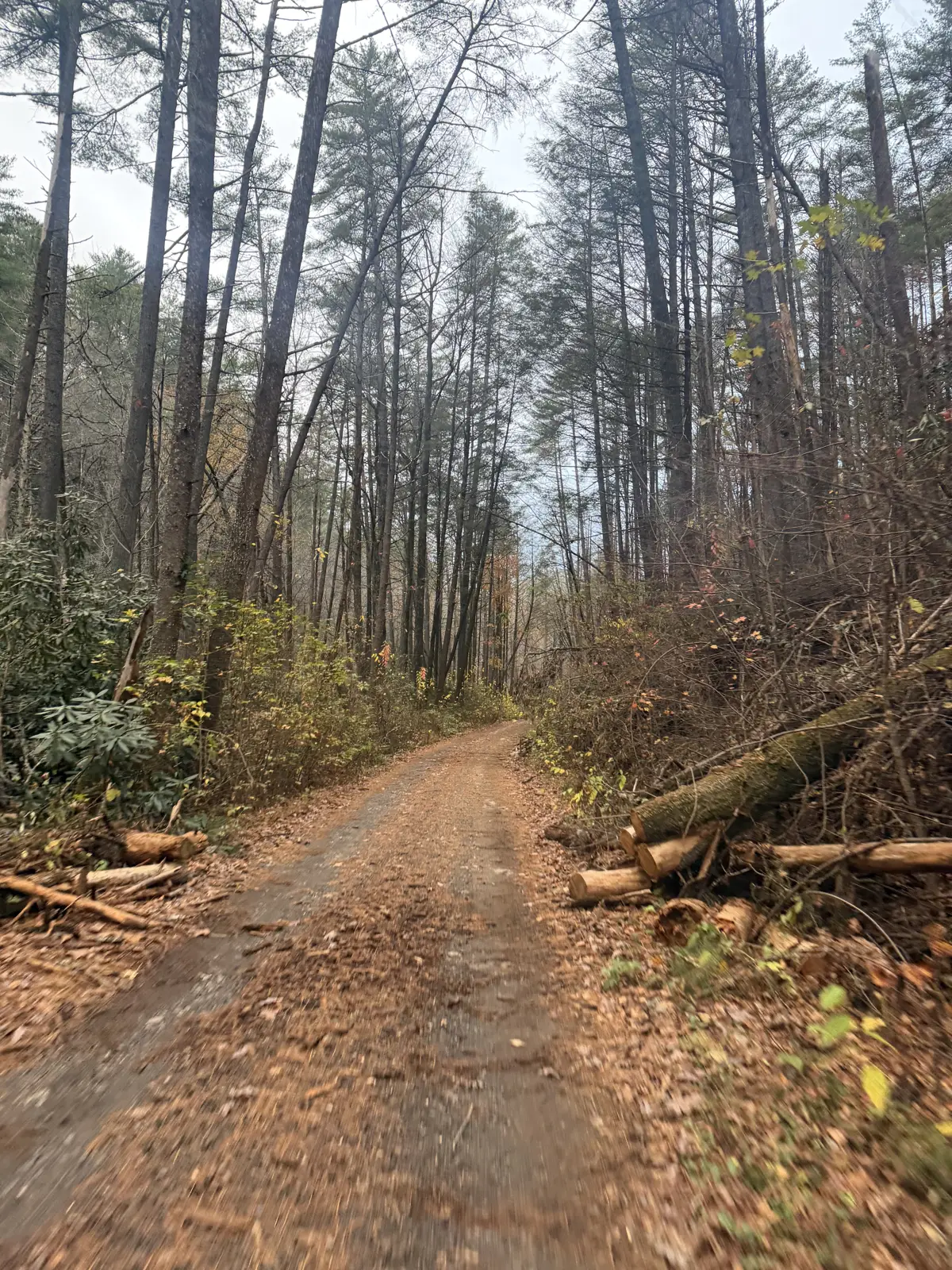
At some point I crossed into Tennessee. Nothing marked the line, and nobody noticed. I only knew I'd made it when I started riding the trails above the Ocoee River. I'd ridden them once, a long time ago, and they're good trails, mostly smooth. But they were buried in leaves, which made the riding slow and a little reckless. The few rocks out there were completely invisible. It felt like playing roulette: a rock could jump up out of the leaves at any moment. I had a few close calls.
I got down to the river and crossed on the suspension bridge at the old Ocoee Whitewater Center. The center was built for the 1996 Summer Olympics as the venue for canoe and kayak slalom. The riverbed was reshaped with concrete and rock to make the course, but it was still a real river, and it remains the only natural riverbed ever used for the Olympics. Most slalom courses are artificial channels, with plastic blocks for rapids and pumps that send the water back to the top. The center burned to the ground in 2022.
I have great memories of that place from when I was a kid. I even got 12 stitches in the parking lot. I was in middle school, kayaking with my Dad, when I flipped and split open the skin over my right eye. The gash was substantial, but my eyebrow hid it pretty well. My Dad is a doctor, and because I was always getting hurt as a kid, he kept a suture kit in the car. He had me lie down on a rock at the edge of the parking lot and sewed me back up right there. Then we went back to paddling until the swelling threatened to shut my eye. It stayed swollen shut for about a week, an excuse I happily used to get out of swim practice. I wasn't about to put goggles over that eye.
On November 4th, nine days before the race, the Ocoee flooded. It crested at 18.05 feet, the highest in recorded history. There were a few minor reroutes because of it, nothing major. From the Whitewater Center I rode a couple of miles along the riverbank, where the evidence was everywhere: washed-out sections of trail, flood debris scattered through the woods. But the trail was still rideable, and soon I was climbing again, up to the Tanasi trail system near Ducktown.
I stopped in Ducktown to resupply and saw Max leaving town as I rolled in. That put him about eight minutes up, but he'd said he was stopping at the next town, so it didn't really matter. My GPS tracker wasn't working, which meant nobody had any idea where I was. I spent ten minutes trying to fix it, gave up, and disappeared back into the woods.
As the sun went down, the clouds started to look a lot angrier. It wasn't supposed to rain, and I knew that if it did, I'd be in serious trouble. I was already worried about staying warm through the night. The forecast low was about 30 degrees, and I had just enough clothing to make it through. Not enough to be comfortable, and certainly nothing extra. Even the smallest amount of moisture would upend my race. It would upend everyone's race. There's not much you can do about 35-degree rain. You just get cold, and there's no way around it.
Much to my horror, it started to rain. Rain might not even be the right word. I'd call it an intense drizzle. Either way, it was more than enough to make me miserable right away. As it got dark and I kept grinding up a long climb, I slowly came to terms with the fact that it was going to be a long, miserable night. Near the top, the rain turned to icy pellets, which was great, because they bounced off me instead of soaking in. Then the descent turned them back into rain, and I was insufferably cold. I put on every layer I had and got to a place I'd call safe, but certainly not warm. Safe, as in not so cold that I was worried about frostbite or hypothermia. Still miserably cold. That would be the feeling for the rest of the night.
I rolled into Blue Ridge a little after 7:00 p.m. I ate some gas station pizza, drank a Monster, and filled my bottles. I'd started the race with 32 ounces of maple syrup in my bottles, over 800 grams of carbs, and it had been my main fuel all day. I ate a few small solid things along the way, a Pop-Tart here, some Fig Newtons there, but mostly I'd been running on beautiful UnTapped maple syrup. It worked great, too. I felt strong, and I knew my nutrition was going really well. So far.
I also got my tracker working! It showed Max was still in Blue Ridge, and I assumed he was done riding; this was where he'd told me he would stop. I'd spotted him up the road on the way into town, so even if he kept going, I'd closed the gap and would pass him soon. As miserable as the riding was, this was my time to shine. In the misery, I excel. I don't enjoy the misery, but I lean into it, and I have confidence in my ability to endure it, to embrace it, better than my competitors.
The night passed slowly and quickly at the same time. Every hour dragged, but by 1:00 a.m. I could look back over the hours behind me and feel good about how I was moving. The sun had set at 5:30, so I was in for about fourteen hours of darkness, which is brutal. The drizzle came and went. Sometimes it snowed, but mostly it rained. On the descents I froze. On the climbs I felt okay, sometimes. The cold was penetrating, and I could feel it zapping my energy. I was far more tired than I should have been, and I knew the cold was why. There was nothing to do but keep going. If I stopped for a quick nap, I knew I'd wake up hypothermic.
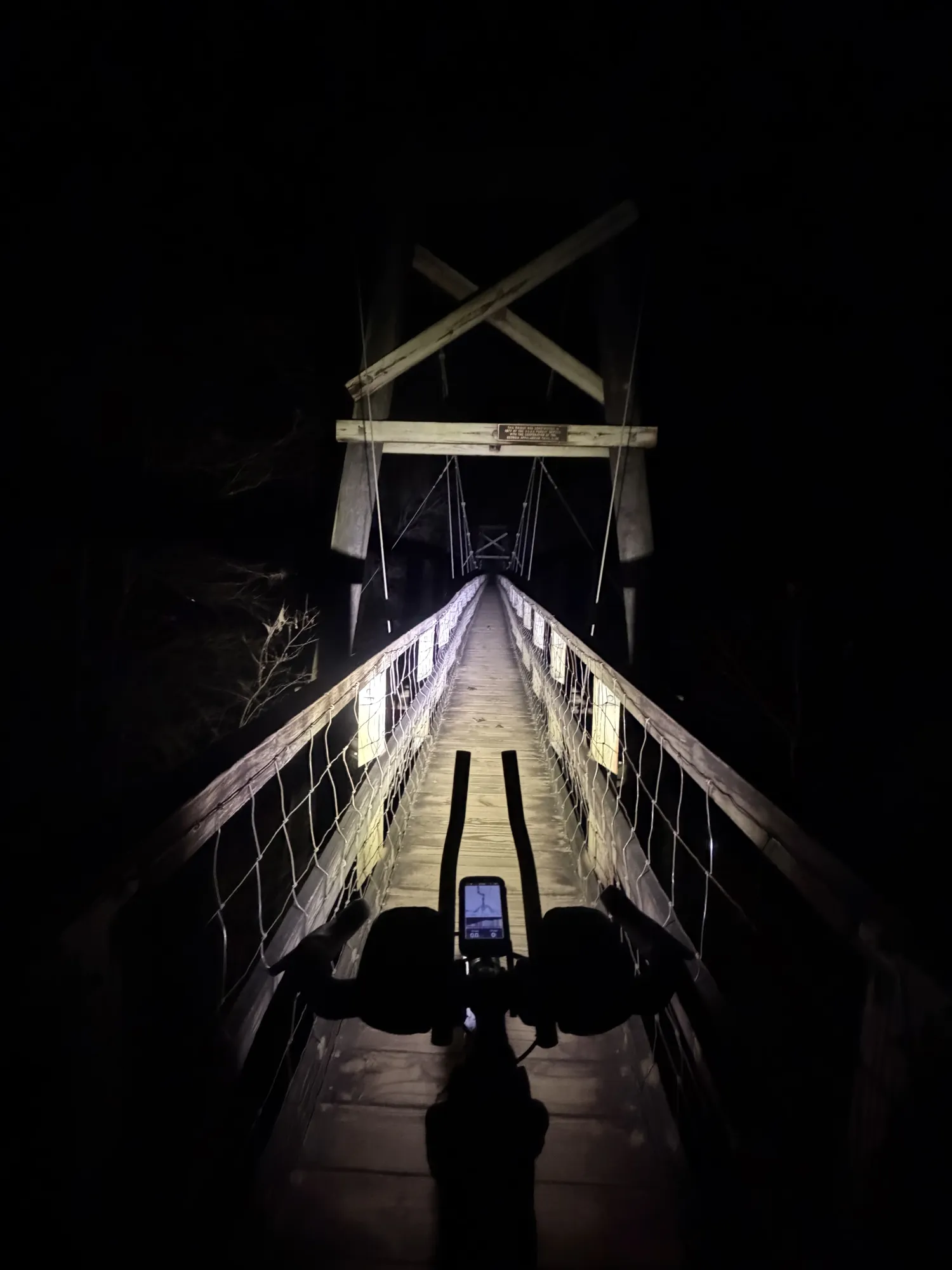
At 4:00 a.m., on remote singletrack deep in the Chattahoochee-Oconee National Forest, my bottom bracket started making horrible noises. I knew immediately that these weren't normal creaks. These were the sounds of a bottom bracket that's about to explode. I knew because the same thing had happened to me this summer in Oregon. That one literally imploded: the bearings fell out of their cups, the cups were mangled, and the spindle started grinding on bare metal. I knew right then that my race was over. There was no hope the problem would resolve itself, or even stabilize. It would only get worse until I couldn't pedal, and the longer I rode on it, the more damage I'd do. With every pedal stroke the metal-on-metal grinding got worse. If I tried to finish, I could destroy the spindle, or worse.
I was so irate.
I'd done the hardest parts of the race. I had a seven-hour gap on the FKT and an even bigger one on the other racers. If my bike would just cooperate, I was well on my way to a fantastic ride. The night was almost over. I had valiantly braved the horrid weather and suffered through hour after hour of darkness. Soon the sun would come up, the rain would stop, and I'd have a relatively straightforward ride to the finish.
To help myself through the night, I had allowed myself the guilty pleasure of imagining the feeling of accomplishment waiting for me at the finish line, how good it would feel to finish a race and be proud of the effort. I was already drafting the email to my sponsors, informing them that I am not a dud! I won a race! I set an FKT! I felt strong, executed brilliantly, and am heading into 2027 with my head held high and my sights set on the biggest races in the world!
But no. None of that was true now. I was shattered.
I limped back into Blue Ridge at 6:30 a.m., just as the sun was starting to light up one corner of the sky. I only had 45 miles left, but I had to stop. My body was waking back up with the light, but my ride was over. Just for good measure, one last shower caught me on the way into town, the heaviest rain of the night. I arrived soaked and shivering, found a gas station, and slouched into a miserable heap in the corner. I choked down some coffee and waited for my Dad to come pick me up.
Sitting there, I kept doing the math. If my bike hadn't broken, I would have finished in about 27 hours, beating the old FKT by seven hours and the eventual winner of the 2026 Cohutta Cat by twenty-six. But it's not about winning, or even about FKTs. This race, for me, was about finishing and putting down a ride I could be proud of. To get that close to the finish and be denied by a mechanical I had no control over is infuriating.
I had fun riding my bike, but a lot of that race was miserable. Riding through the night in cold rain and snow was one of the hardest rides I've ever done. The suffering made sense in the moment because I was working toward something concrete, a goal. Then suddenly it felt like all of it was for nothing. Of course it wasn't for nothing. Every experience is valuable, and I still had fun out there. But it's understandable that my suffering suddenly felt like a foolish waste of time.
Worst of all, this DNF feeds a fire of self-doubt that I can't beat back. I have failed this year. I have repeatedly failed this year. I haven't excelled in a single race. Failure and setbacks are part of this sport, but to go zero for six... that hurts. It makes me feel demoralized and makes me question my standing as a "pro ultra cyclist." And I can't help but think about my sponsors, and how they look at my repeated failures.
When my Dad pulled up, I peeled myself off the floor and wheeled my bike out into the gray morning.
The tides will change in 2027, inshallah.